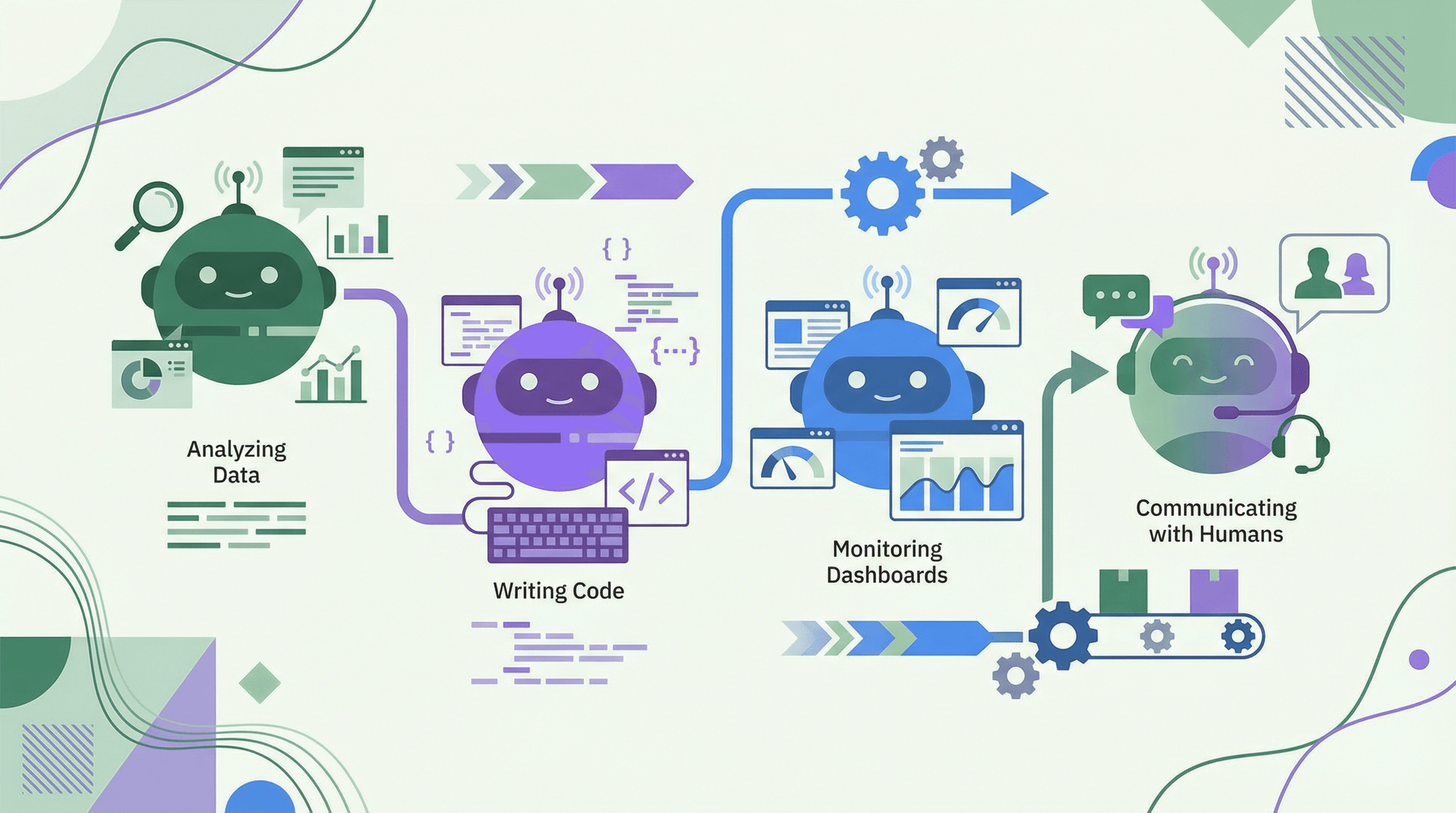
AI agents — autonomous systems that can plan, execute multi-step tasks, and use tools — are the most exciting and most dangerous development in software engineering right now. They are exciting because they can automate complex workflows. They are dangerous because when they fail, they fail in unpredictable ways.
At KodexApps, we have deployed AI agents in production systems for code review, data processing, and customer support augmentation. Here is what we have learned.
Agent Reliability Is Not Model Reliability
A language model that is 95% accurate sounds impressive until you chain 10 steps together. At each step, errors compound. A 10-step agent with 95% accuracy per step has only a 60% chance of completing the full task correctly.
Our approach to reliability:
Checkpoint and validate. After each step, validate the output before proceeding. This catches drift early.
Idempotent actions. Every tool the agent can call should be safe to retry without side effects.
Human-in-the-loop. For high-stakes actions (sending emails, modifying data, making payments), require human approval.
Timeout and budget limits. Agents should have maximum step counts, time limits, and cost ceilings.
Guardrails That Work
Input sanitization — validate and constrain what users can ask the agent to do
Output filtering — scan agent responses for PII, profanity, or off-topic content before presenting to users
Action whitelisting — agents should only have access to explicitly approved tools and APIs
Audit logging — record every agent decision, tool call, and output for debugging and compliance
Cost Management
AI agents can be expensive. A single complex task might require 10-20 API calls to a language model, each costing fractions of a cent. At scale, this adds up fast.
Use smaller, faster models for simple sub-tasks (classification, extraction)
Cache common tool call results to avoid redundant API calls
Implement per-user and per-task cost limits
Monitor cost-per-task metrics and optimize the most expensive workflows first
When Not to Use Agents
Agents are overkill for most tasks. If you can solve the problem with a simple prompt or a deterministic pipeline, do that instead. Use agents only when:
The task requires multi-step reasoning with branching logic
The task needs to use multiple tools in a sequence that varies by input
The cost of the agent is justified by the value of automation
AI agents represent the frontier of our Dream. Develop. Innovate. philosophy — we dream about intelligent automation, develop it with rigorous guardrails, and innovate on reliability patterns as the technology matures.