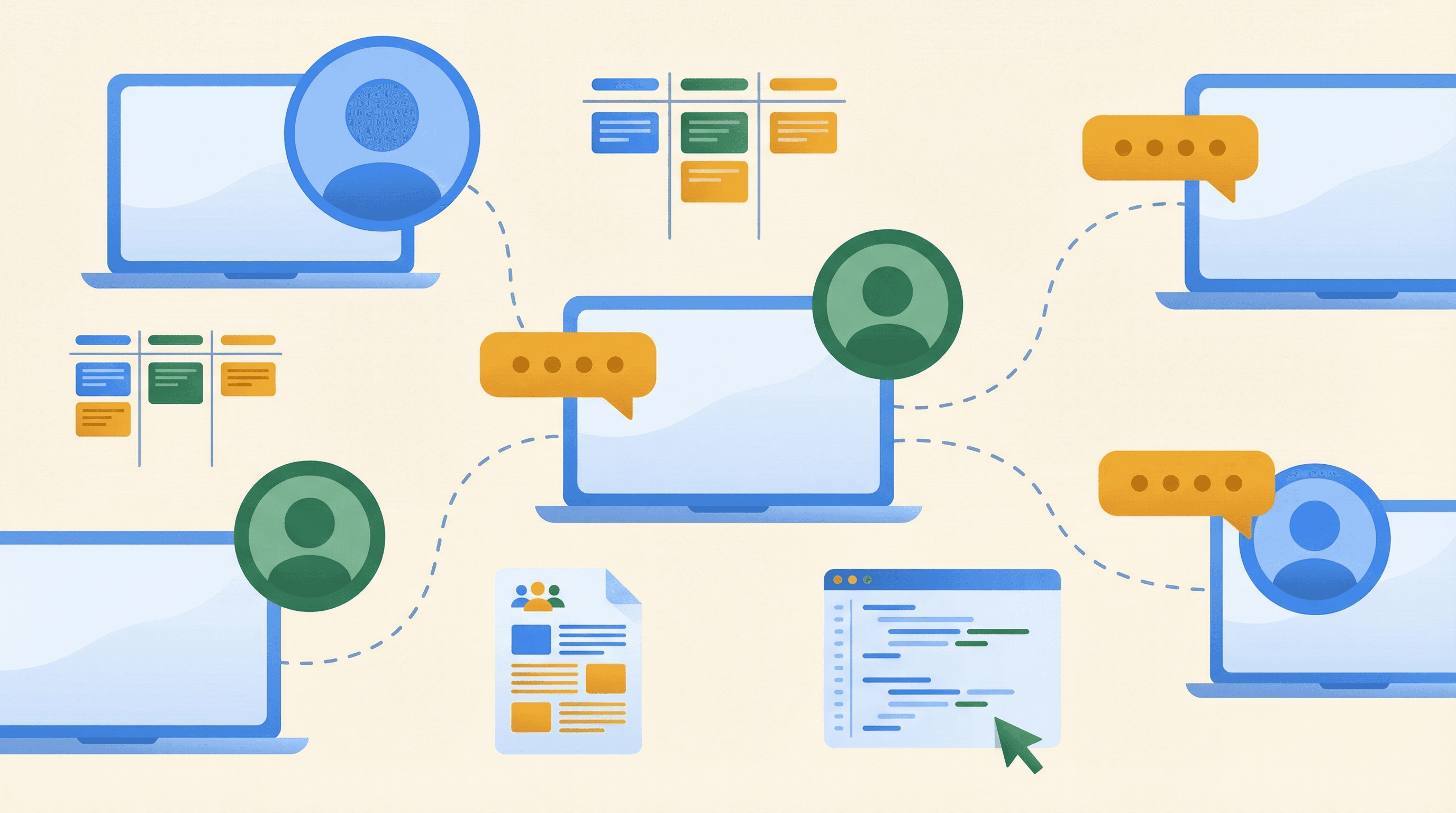
Remote work is here to stay, but the tools have not kept up. Most video conferencing tools were designed for scheduled meetings, not for the organic, all-day collaboration that makes teams productive. When we built Kino Live, we had to rethink what remote collaboration software could be.
The Problem with Current Tools
Zoom, Teams, and Google Meet share the same fundamental limitation: they model communication as discrete meetings. You schedule a call, join, talk, leave. But in a physical office, most valuable interactions are spontaneous — a quick question across the desk, an impromptu whiteboard session, overhearing a conversation that gives you context.
Kino Live was designed to recreate this spontaneity in a digital environment.
Technical Challenges We Solved
Sub-200ms Latency
For always-on video to feel natural, latency must be imperceptible. We achieved sub-200ms end-to-end latency by:
Using WebRTC with custom SFU (Selective Forwarding Unit) servers
Deploying edge nodes in multiple regions to minimize hop count
Implementing adaptive bitrate streaming that responds to network conditions in real-time
Optimizing the encoding pipeline for low-latency over quality when bandwidth is constrained
Spatial Audio
When 20 people are in the same virtual space, you cannot hear all of them at once. Spatial audio creates proximity-based conversations: voices get louder as you move closer and fade as you move away. This required custom audio mixing on the server side with per-user gain calculations based on virtual position.
Battery and CPU Optimization
An always-on video app that drains your laptop battery in two hours is useless. We invested heavily in optimization:
Reduce video resolution for off-screen participants to thumbnail quality
Pause video streams entirely for participants in different "rooms"
Use hardware video encoding where available
Implement intelligent focus detection to prioritize the active speaker
What We Learned About Remote UX
Presence matters more than features. Seeing your team in a shared space all day is more valuable than any feature.
Low friction is everything. One-click to join, always-on by default, no meeting links.
Privacy controls are non-negotiable. Camera off, do not disturb, and private rooms are essential for all-day use.
Kino Live embodies our Dream. Develop. Innovate. ethos — we dreamed of a world where remote teams feel as connected as in-office ones, developed the technology to make it real, and continue to innovate on the remote work experience.